Blog Assist
2026-07-15 · 8 min read
A weekend Streamlit script for auto-posting to WordPress, grown into a self-hosted, multi-tenant blogging agent that researches, writes, and publishes on autopilot — and learns your writing style from feedback.
- Category
- AI
- Status
- Live
- Role
- Solo — brand, product & engineering
- Stack
- FastAPIAPSchedulerSQLAlchemyJWT AuthWordPress REST APIVanilla JS
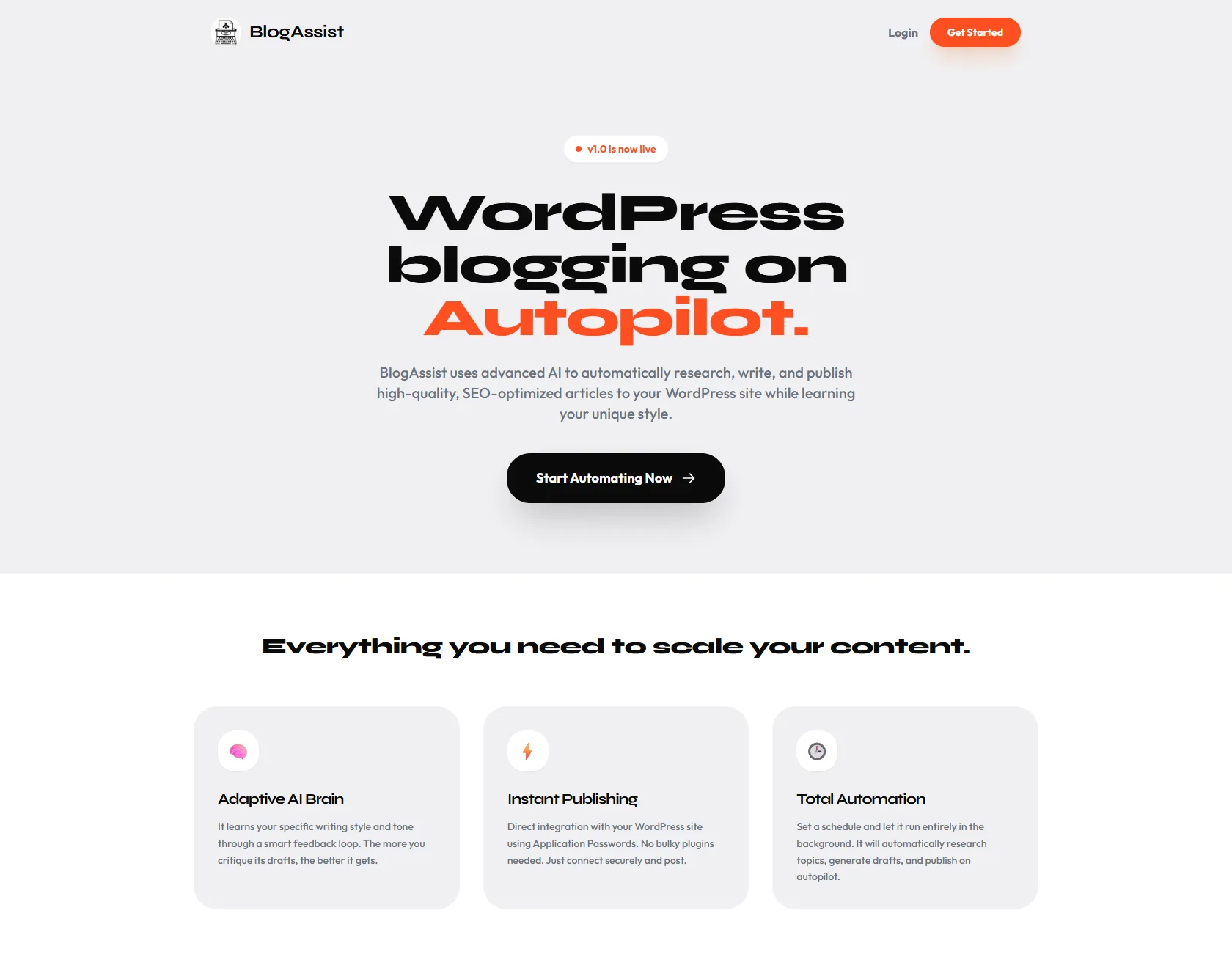
BlogAssist landing page
Content creation doesn't scale by itself
Writing high-quality, SEO-optimized blog posts consistently takes real time, effort, and domain expertise — and it's the first thing that gets dropped when an agency or a solo founder gets busy. The obvious digital shortcuts don't quite fit the job either.
Raw LLMs are powerful, but they hand you a wall of text. Someone still has to copy it, format it, and log into WordPress to upload it — every single time. Heavy SaaS writers, on the other hand, come with bloated dashboards, recurring subscriptions, and your content and credentials living on someone else's server instead of yours.
BlogAssist Pro starts from a different premise: configure it once, and let it run forever in the background. It keeps the workflow a blogger already trusts — drafting, editing, WordPress publishing — but removes the subscription, the manual babysitting, and the learning curve. It's self-hosted, so your API keys, your WordPress credentials, and your generated content never leave your own database. And it's built for zero daily touch: set a topic and an interval — anywhere from once a minute (for testing) to once a week — and the agent takes it from there.
A self-hosted engine built for hands-free content
BlogAssist Pro pairs a decoupled FastAPI backend with a Vanilla JS + Tailwind frontend around one goal: generate, review, and publish blog content without anyone sitting at a keyboard.
The dashboard is the command center — a total-posts counter, a Weekly Activity chart of real published posts, a pulse-animated "Auto-Pilot Active" badge with a live countdown to the next run, and four agent controls: Start Auto, Stop Auto, Preview Draft, and Instant Publish.
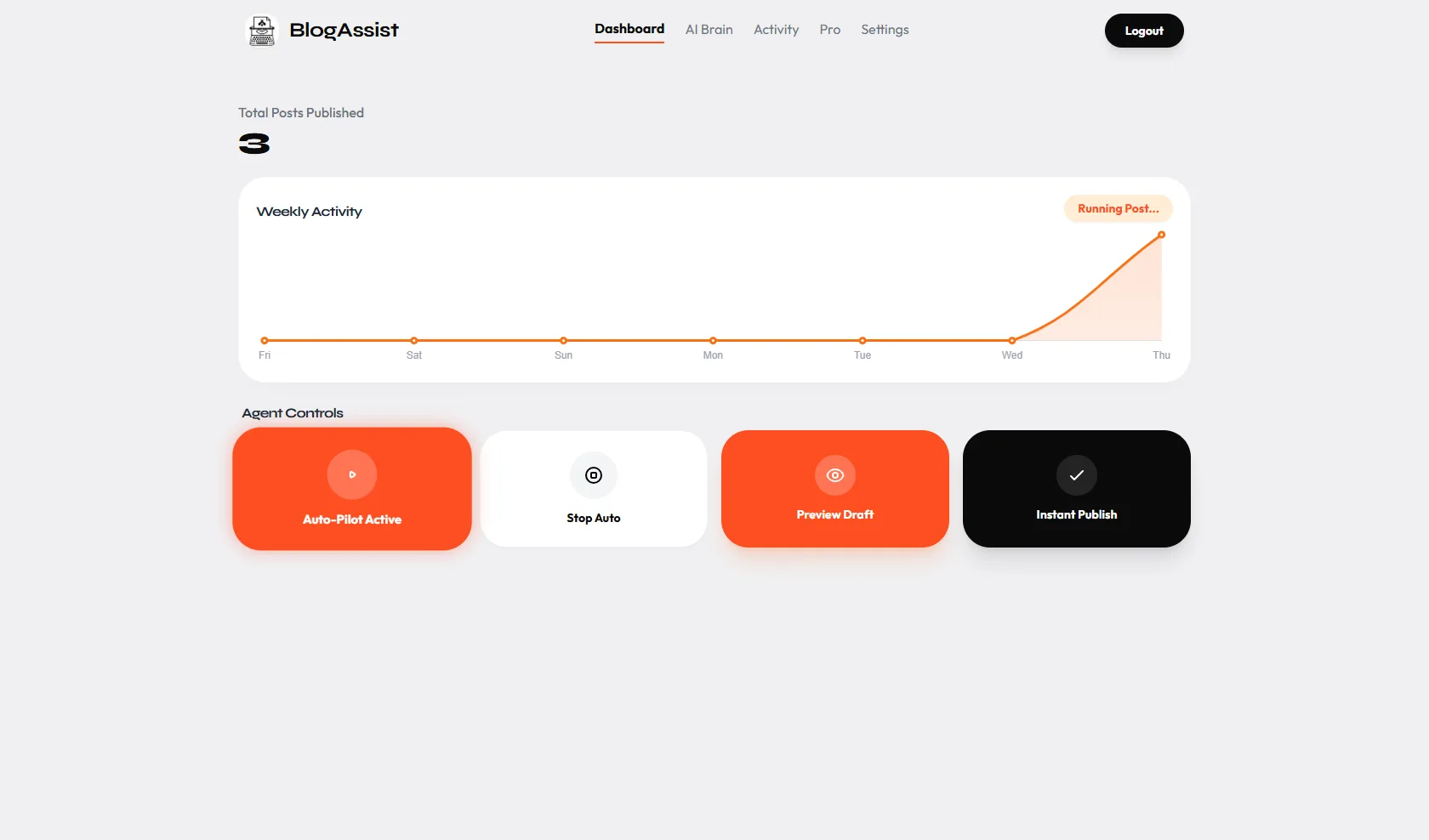
BlogAssist dashboard with weekly activity chart and agent controls
Everything else lives behind a real settings screen — AI provider and API key, WordPress URL/user/app-password, topic, word count, a schedule anywhere from 1 minute to 168 hours, post status, and even a Google Analytics ID. Every field is validated live, against both the LLM provider and the WordPress REST API, before it's saved.
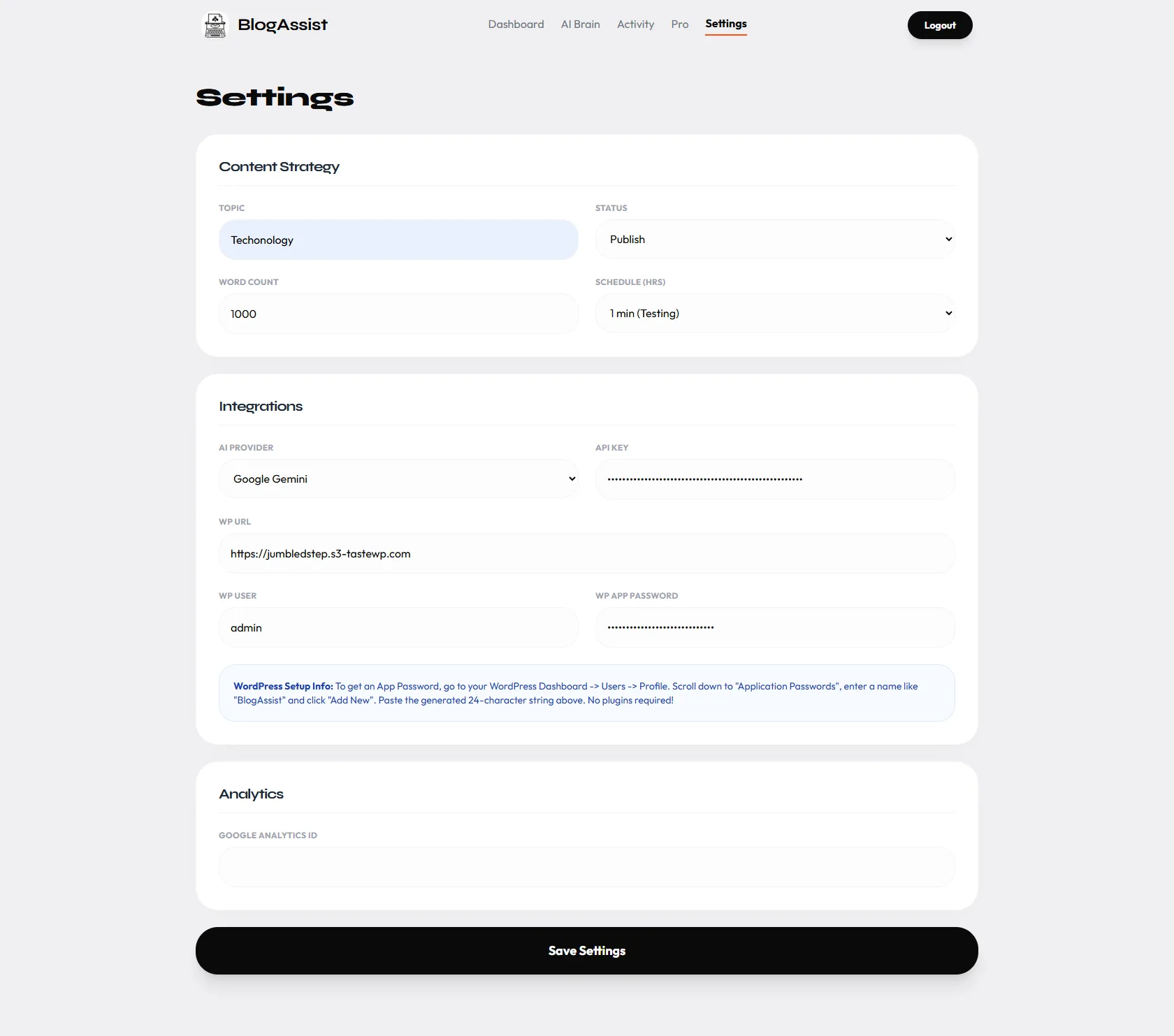
BlogAssist settings screen
And because a background agent is only trustworthy if you can see what it's doing, there's a live, scrolling Activity Log — every generation cycle, every WordPress publish, every start and stop, timestamped and polled in real time.
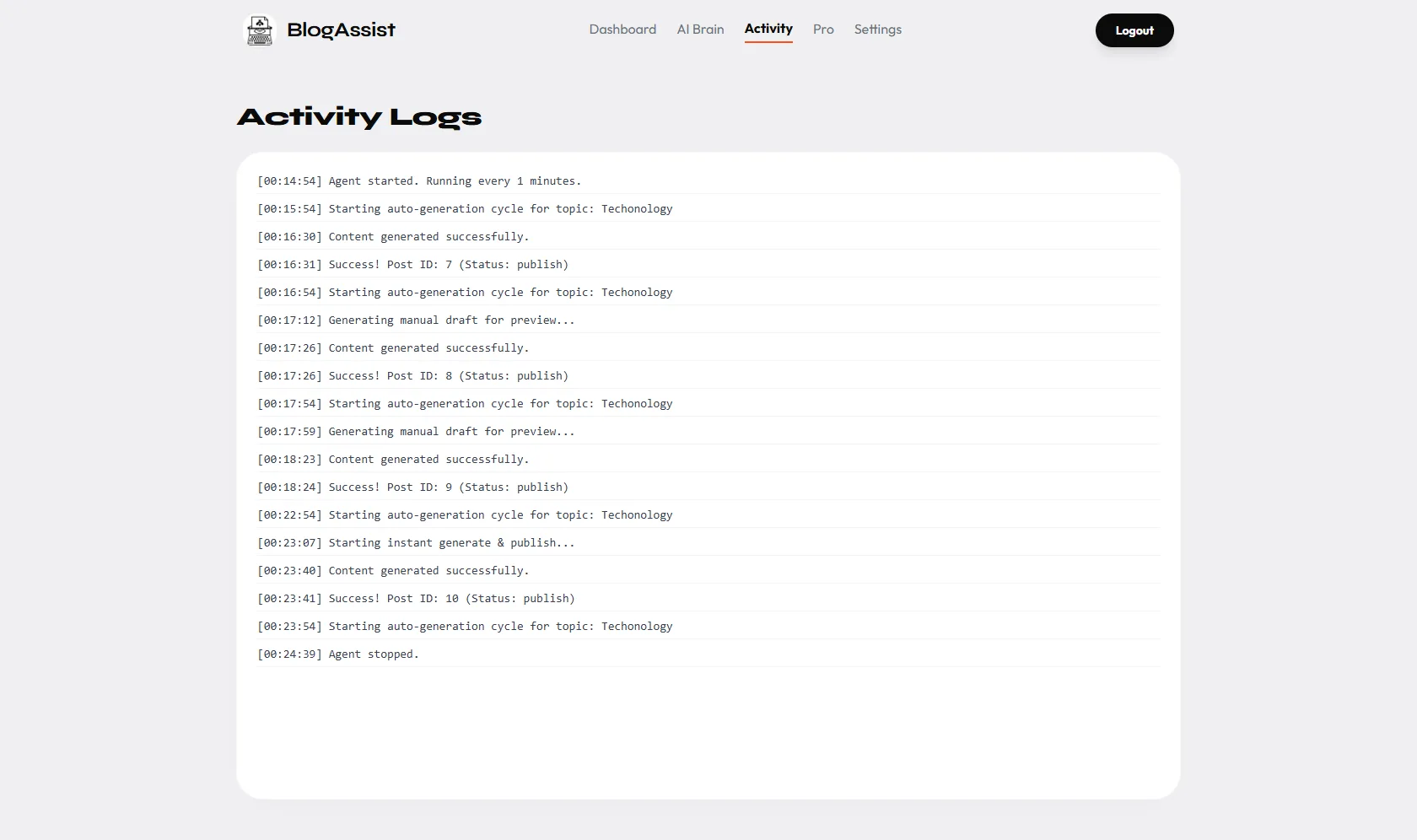
BlogAssist activity log terminal feed
How it compares
| Feature | BlogAssist Pro | Manual WordPress | SaaS AI Writers |
|---|---|---|---|
| Fully Autonomous | Yes | No | Rarely |
| Data Ownership | Local / Self-hosted | Yes | Cloud Vendor |
| Background Scheduling | Yes (APScheduler) | No | Varies |
| Learns Your Style | Yes (Feedback → Rule) | N/A | Rarely |
| Multi-User Ready | Yes (JWT accounts) | No | Yes |
From a personal script to a multi-tenant product
The original build proved the concept for one user, on one machine. The current codebase turns that into an actual product surface — accounts, a real landing page, and a feedback loop the agent can learn from.
- Accounts & Multi-Tenancy — JWT-based login and registration (OAuth2 password flow, bcrypt hashing). Every
Config,Log,Post, andStyleGuidelinerow is scoped to auser_id, and each user's scheduler job runs under its own namespaced job ID (auto_post_{user_id}), so one server can safely run many agents in parallel. - Guided Onboarding — a three-step wizard (Connect your AI → Connect WordPress → Define Strategy) replaces a blank settings page for first-time users, with credentials validated live before the account is marked ready.
- Style Feedback Loop — critiquing a draft doesn't just rewrite it. The same call asks the model to extract one generalized, under-15-word style rule, which is stored and silently re-injected into every future prompt.
- Public Landing Page — a proper marketing front door sitting in front of the authenticated app, in the same orange-and-black visual language as the dashboard.
Multi-tenant support was on the "Next" list in the original roadmap. It's now shipped: the scheduler, the database models, and the auth layer were all rebuilt around user_id as a first-class citizen rather than bolted on afterward.
Four calls that shaped the architecture
1. Decoupled FastAPI + Vanilla JS over Streamlit. The first version was a Streamlit script; it proved the idea but couldn't run true background jobs. Every screen now talks to a REST API instead. Trading React/Vue for plain HTML/JS was deliberate — zero build step, instant iteration.
2. APScheduler with thread-safe DB sessions. Background loops crash easily on detached SQLAlchemy instances. Config values are extracted into plain variables before they're closed over by the scheduler thread, and a FastAPI startup hook re-arms any agent that was mid-run when the server restarted.
3. Zero-plugin WordPress auth. Instead of shipping a custom WP plugin, the agent authenticates with native WordPress Application Passwords over Basic Auth — one less moving part to install, update, or break.
4. Prompt-injected style memory over fine-tuning. Rather than fine-tuning a model per user, feedback is distilled by the LLM itself into a short rule and stored as plain rows. Every future prompt replays the accumulated rules — personalization with no training cost.
Watching the agent learn
The two screens that make BlogAssist feel less like a script and more like a collaborator: a reviewable draft, and a growing memory of how you like things written.
Every draft opens in an editable Preview & Critique modal — the title and body are directly editable, quick-critique chips ("More Professional," "More Casual," "Shorter Sentences," "More Lists") sit next to a free-text box, and two buttons close the loop: Rewrite & Learn or Approve & Publish.
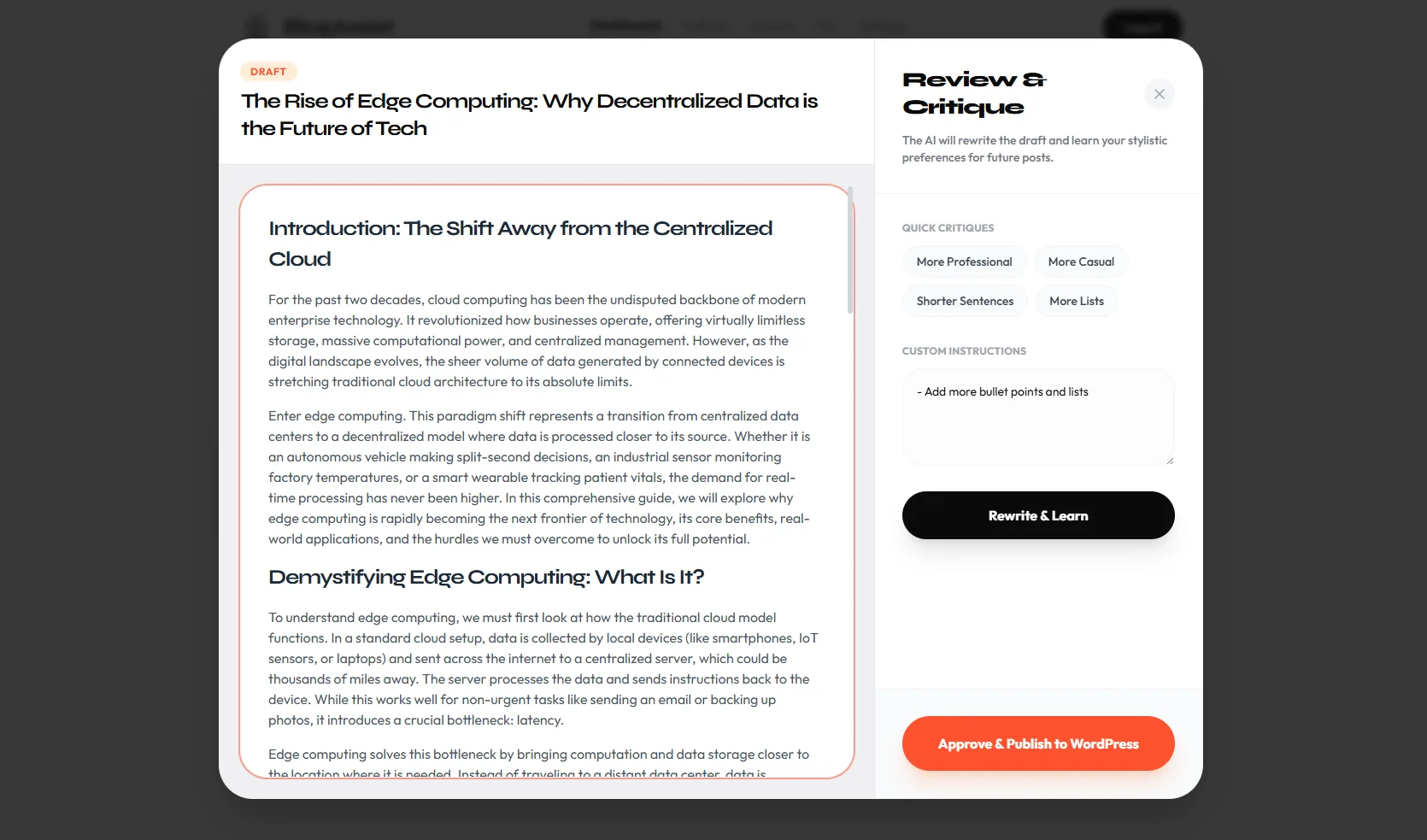
Preview and Critique modal with editable draft and feedback panel
Whatever gets typed into that feedback box doesn't just reshape the current draft — it gets distilled into a permanent rule. In one real run, a single round of feedback ("more casual, more lists") was enough for the agent to permanently learn: "Use short sentences, a casual tone, and frequent bulleted lists." That rule now lives in the AI Brain screen — a running, deletable list of everything the agent has picked up from feedback — and gets silently re-injected into every generation from that point forward.
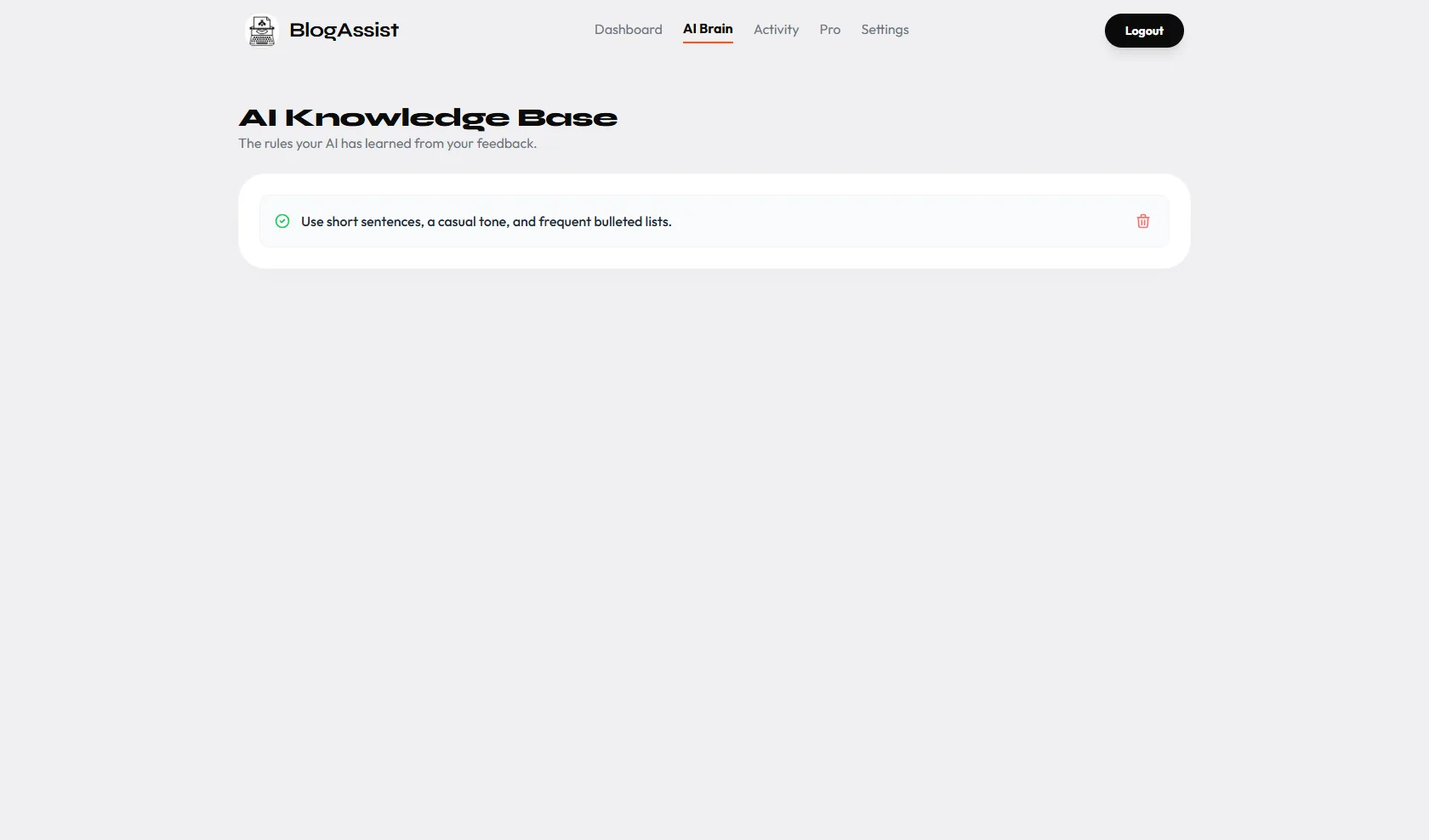
AI Brain screen showing a learned style rule
From agent to a live WordPress post
The full loop, closed: the agent runs on its schedule, the post lands in WordPress with the right status, and it renders on the live site — no manual copy-paste anywhere in between.
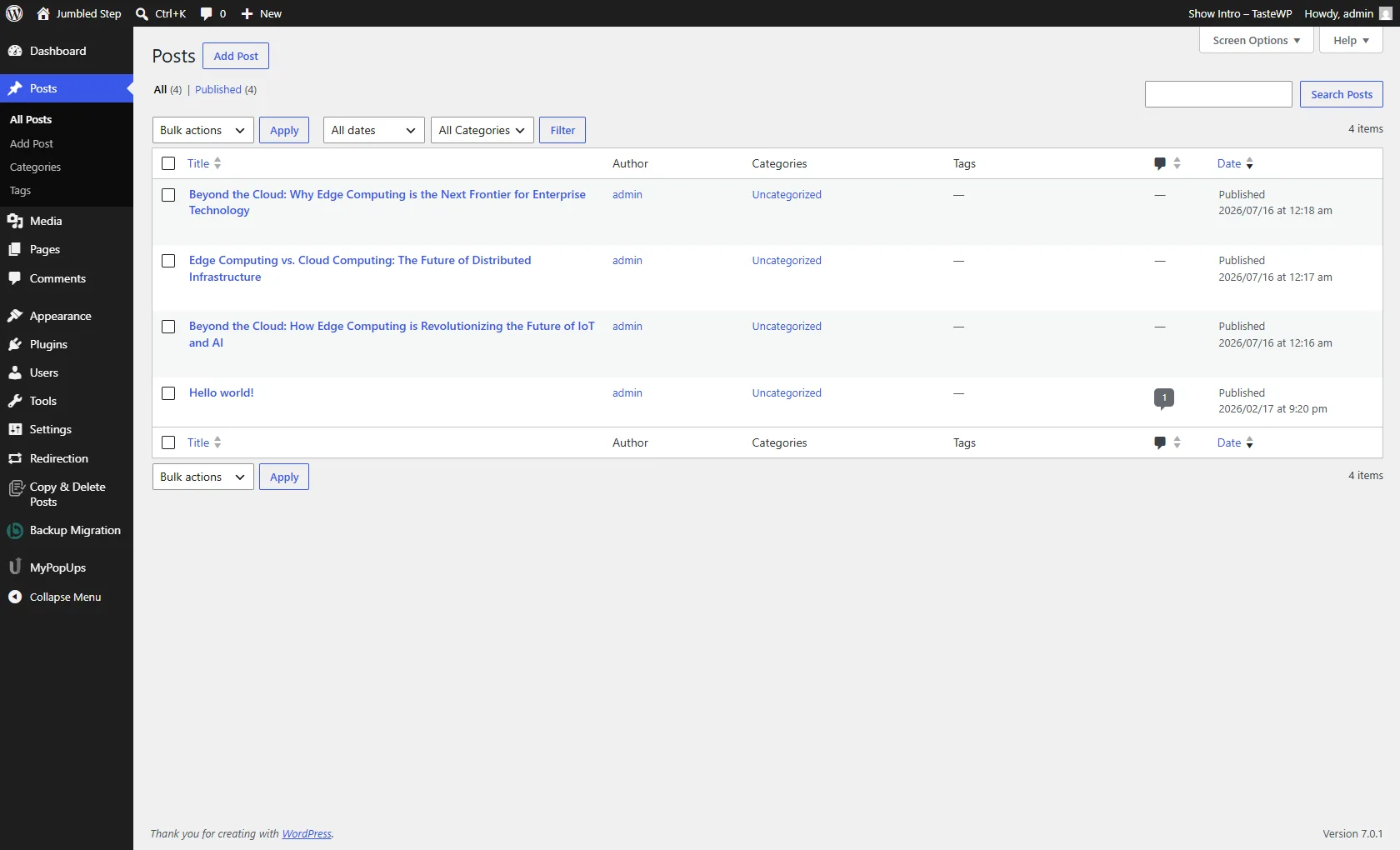
WordPress posts list showing 4 posts published autonomously

Live published blog post, mid-article, with real headings and bullet lists
"Beyond the Cloud: Why Edge Computing is the Next Frontier for Enterprise Technology" — drafted, formatted with real headings and bullet lists, and pushed live to jumbledstep.s3-tastewp.com entirely by the scheduled agent.
The build story
The project's fix log reads like a running journal — one issue, one status, one action per entry — the exact record an agentic coding tool leaves behind while working through a punch list.
| Phase | Milestone | Status |
|---|---|---|
| 1 | Streamlit MVP — basic LLM → WordPress connectivity | ✅ Done |
| 2 | FastAPI migration — Vanilla JS frontend with Tailwind | ✅ Done |
| 3 | Scheduling hardening — APScheduler + DetachedInstanceError fix | ✅ Done |
| 4 | UI overhaul — countdown timers, Auto-Pilot active states | ✅ Done |
| 5 | Multi-tenant + AI Brain — JWT accounts, onboarding, feedback loop, landing page | ✅ Done |
| Next | Image generation + advanced SEO | 🕓 Planned |
By the numbers: 5 DB models (User, Config, Log, Post, Guidelines) · 10 configurable settings · 4 agent controls · 24/7 autonomous runtime · a 1-minute-to-168-hour schedule range · 2 LLM providers plus a Simulated mode for testing without burning API credits.
Built with real agentic help, end to end
This project leaned on agentic coding tools for both implementation and debugging, while every product decision traced back to a concrete workflow need.
Human — ideation & product decisions. Choosing WordPress Application Passwords over a plugin, decoupling from Streamlit, adding a "fire and forget" countdown timer, and later — rebuilding the whole thing around accounts — all came from the builder's own workflow, not a template.
AI — implementation, via Google Antigravity. Google's agentic IDE handled the architectural migration: writing the FastAPI backend, styling the Vanilla JS frontend, diagnosing SQLAlchemy DetachedInstanceErrors from raw log traces, and later implementing the JWT auth layer and the feedback-to-rule extraction logic.
What it excelled at: refactoring a monolithic Streamlit script into a decoupled, multi-tenant API architecture; diagnosing specific ORM threading bugs from log traces and fixing them directly; translating UI requirements into working Vanilla JS logic — the live countdown timer, the contenteditable draft preview, the polling activity log; and handling Git operations, .gitignore hygiene, and clean, incremental commits autonomously.
What's next: auto-attaching DALL·E or Midjourney feature images to every post, and auto-generated meta descriptions, tags, and internal linking between posts.
Closing thought
BlogAssist Pro is a working answer to a specific problem — built, hardened, and now running on autopilot.
Links: blogassist.vinamra.dev · github.com/vinamrapandey/Blog-Assist · MIT License · vinamra.dev
Have something in mind?
Let's build it together.